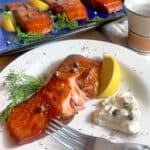
The Besst Smoked Salmon Recipe
Learn how to make the best smoke salmon with this smoked salmon brine that features cold water, kosher salt, brown sugar and a glaze of pure maple syrup. Use this as a Traeger smoked salmon recipe or any other type of smoker.
Servings: 12
Equipment
Ingredients
- 6 lbs salmon
Smoked Salmon Brine Recipe
- 1 quart cold water 1,000 ml.
- 1/2 cup kosher salt 90 grams, or about 6 level tablespoons Morton's brand.
- 1/2 cup dark brown sugar 110 g.
Optional Seasoning
- 1 tsp dill weed
- 1 tsp thyme
- 1 tsp lemon-pepper
- 1 tsp garlic powder
For the Glaze
- 1/2 cup maple syrup
Instructions
Make the Smoked Salmon Brine and Soak It
- Use a large bowl and mix the water, salt, and brown sugar for the smoked salmon brine. Take a fork and stir it for a few minutes to make sure the solids are dissolved in the water. Add the dill weed and thyme.
- Place the salmon fillets on a large cutting board. Using a sharp knife, carefully slice the fish into 2 to 3-inch portions. Leave the skin on. Place the fish in the brine, cover with plastic wrap and refrigerate for 5 hours.
Dry the Fish
- After it has marinated in the smoked salmon brine, place the fish skin side down on a cooling rack Use a paper towel to gently pat salmon dry. Ideally you should do this where there is a cross-breeze. You can also use a small fan for this purpose. Allow it to dry for a minimum of 2 or 3 hours. This is one of the most important steps! It is critical for a slightly sticky sheen to develop. This is called a pellicle. The pellicle seals the salmon and helps to hold the smoke and it helps keep the salmon from drying out. Once the fish is dry, apply a liberal dusting of lemon-pepper seasoning and a touch of garlic powder.
How to Smoke Salmon
- Place a water pan below the grates of our smoker and fill it with hot water. Then, place salmon on the smoker and start out on low heat at 140-150°. Brush the fish with pure maple syrup every 45 minutes. After a couple of hours, gradually bring the temperature up to 180°. Your target internal temperature is 130-135°.
Notes
- If you smoke too high too fast you'll get a fair amount of white stuff called albumin. Some is OK and expected. The less you get, the more moist your fish will be.
- Try not to let the pieces get above 140°. They start to dry out pretty fast above that.
- Experiment with the smoked salmon brine recipe and add dry herbs like thyme and garlic. Let your taste buds guide you.
Nutrition
Calories: 395kcal | Carbohydrates: 18g | Protein: 45g | Fat: 14g | Saturated Fat: 2g | Polyunsaturated Fat: 6g | Monounsaturated Fat: 5g | Cholesterol: 125mg | Sodium: 4819mg | Potassium: 1161mg | Fiber: 1g | Sugar: 17g | Vitamin A: 100IU | Vitamin C: 1mg | Calcium: 54mg | Iron: 2mg
QR code
Scan this QR code with your phone's camera to view this recipe on your mobile device.
